
Club Penguin is defined as a browser-based multiplayer online game where players create and control penguin avatars to socialize, play minigames, and explore an Antarctic-themed virtual world. Launched on October 24, 2005, the game ran until March 30, 2017, and attracted over 200 million registered users at its peak. It combined social interaction, creative customization, and child-safe moderation in a way no major platform had done before. Parents trusted it. Kids loved it. And its influence still shapes online social gaming today.
What is Club Penguin and how did it work?
Club Penguin is a massively multiplayer online game, commonly called an MMO, built around penguin avatars in a snow-covered virtual world. Players waddled through themed rooms, chatted with other players, adopted virtual pets called Puffles, and earned in-game currency called coins by playing minigames. The game targeted children ages 6–14 and built its entire design around keeping that audience safe and engaged. Every feature, from the chat filter to the moderated rooms, served that goal.
The core loop was simple but effective. You logged in, picked a server, and entered a shared world where hundreds of other penguins were already hanging out. You could join a minigame, visit a friend's igloo, or attend a seasonal party event. That simplicity made it accessible to young kids while still offering enough depth to keep older players coming back.
What were the main Club Penguin features?
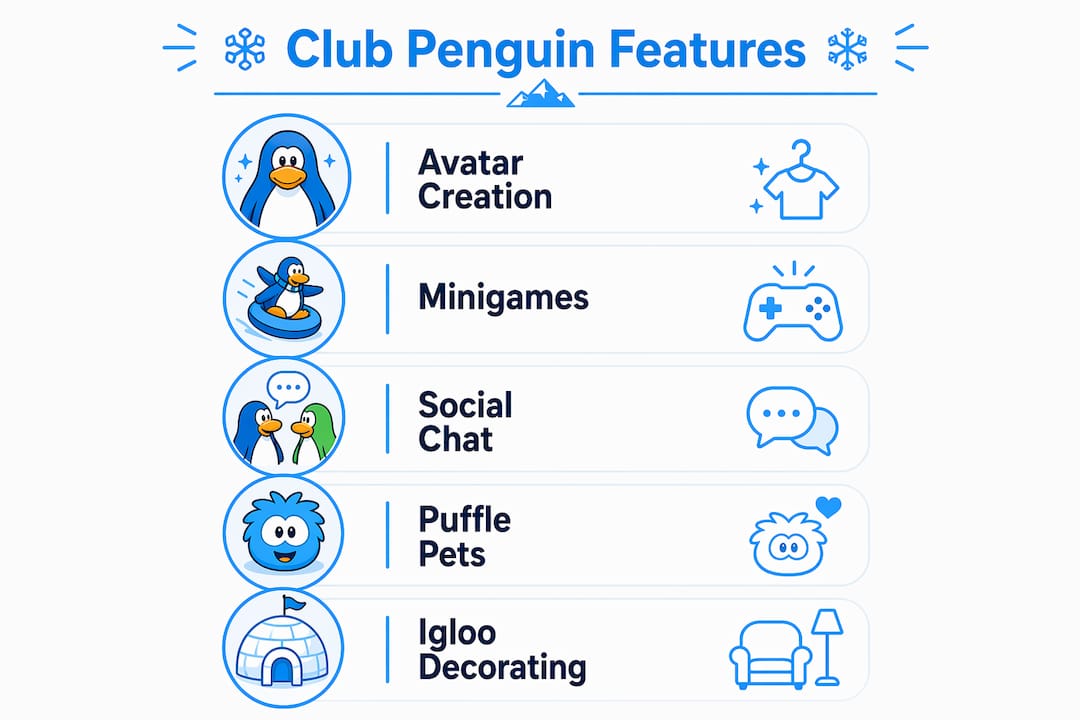
Club Penguin's features covered four main areas: customization, social spaces, minigames, and safety. Each one reinforced the others to create a complete experience.
Customization and personal spaces:
- Penguin appearance: Players chose colors and bought clothing items from the in-game catalog using coins earned through gameplay.
- Igloo decoration: Every player owned a personal igloo they could furnish and redesign. Igloos became a form of self-expression and social status.
- Puffle care: Puffles were small, round virtual pets in various colors. Each color had a different personality. Players fed, played with, and walked their Puffles to keep them happy.
Social spaces and events:
- Themed rooms: The game world included a Coffee Shop, a Ski Lodge, a Night Club, and dozens of other locations that changed with seasonal events.
- Parties: Monthly parties transformed the entire game world with new decorations, exclusive items, and special activities. The Halloween and Holiday parties became legendary among longtime players.
- Safe chat: The game offered two chat modes. Younger players used a preset phrase system. Older players with parental permission could type freely, but a filter blocked inappropriate content.
Minigames:
- Sled Racing, Jet Pack Adventure, and Cart Surfer were among the most popular games for earning coins quickly.
- Card Jitsu became a fan favorite. Interestingly, Card Jitsu originated from fan speculation that the development team later turned into an official game. That kind of community influence was rare for its era.
Pro Tip: If you want to earn coins fast in any Club Penguin recreation, focus on minigames with a time bonus. Cart Surfer and Jet Pack Adventure consistently pay out the most coins per minute of play.
Child safety moderation was not an afterthought. The team employed human moderators and automated filters to create a trusted environment. That combination made Club Penguin one of the few online spaces parents actively recommended to other parents.
How did Club Penguin grow to 200 million users?
Club Penguin's growth story is one of the most remarkable in online gaming history. The founders built the original game on personal credit cards, with no outside marketing budget. The game launched with 15,000 users and grew to over 200 million registered accounts by july 2013. That growth happened almost entirely through word of mouth among children and parents.
| Year | Milestone |
|---|---|
| 2005 | Game launches with 15,000 users, funded by founders' personal credit |
| 2007 | Disney acquires Club Penguin for a reported $350 million |
| 2013 | Registered user count surpasses 200 million worldwide |
| 2017 | Official game closes; mobile transition cited as a key factor |
| 2026 | Fan recreations serve approximately 1 million active users |
Disney's acquisition in 2007 brought resources but also corporate pressure. The game's original team had built something unusual. Artists and creative coders, not traditional engineers, had written most of the game's code. That artist-led technical development produced a charming, expressive game world but made the platform difficult to adapt as technology shifted.
"Club Penguin was essentially training wheels for social media. It gave kids a safe place to learn how to interact online before the real internet got to them." — Chris Heatherly, former Disney executive, on Club Penguin's social role
That framing matters. Club Penguin was not just a game. It was an early prototype for the kind of social virtual world that platforms like Roblox would later scale into a billion-dollar industry. The difference is that Club Penguin put child safety and community first, while later platforms often prioritized growth metrics instead.
Why did Club Penguin close, and what happened next?
Club Penguin shut down on march 30, 2017. The closure came down to one core problem: mobile. Smartphones had become the dominant gaming device for children, and the game's code could not adapt to mobile without a near-complete rebuild. Disney chose to redirect resources toward a new mobile-first product called Club Penguin Island instead.
Club Penguin Island launched in march 2017 and closed in december 2018. It failed to capture the original's community feel. Players found it too different, too thin on content, and too focused on monetization over social connection.
What happened after the closure tells you everything about the game's cultural weight:
- Fan communities immediately began building their own recreations from scratch.
- Multiple volunteer-run servers appeared within months of the 2017 shutdown.
- Some fan projects faced legal challenges from Disney over intellectual property.
- Others adapted by changing visual elements while preserving the core gameplay feel.
- Newcp, known as New Club Penguin, emerged as one of the most active and safety-focused fan recreations still running today.
The fan response was not just nostalgia. It was a community refusing to let a meaningful shared space disappear. Parents who had played as kids in 2007 were now introducing the experience to their own children through these fan-run platforms.
What makes fan-led Club Penguin recreations special today?
Fan recreations of Club Penguin are volunteer-run servers that rebuild the original game's world, features, and community spirit without corporate backing. As of early 2026, fan projects collectively serve around 1 million active users. That number reflects genuine demand, not marketing spend.
Here is what makes the best fan recreations stand out:
- Safety-first moderation. Volunteer teams apply the same child-safe principles the original game used. Human moderators review reports and enforce community rules without automated systems doing all the work.
- Preserved nostalgia. The best recreations keep the original rooms, color palettes, and music that players remember. Walking into the Coffee Shop or the Ski Lodge still feels like coming home.
- New content alongside the classics. Volunteer developers add new party events, clothing items, and minigame updates to keep the experience fresh for players who have already seen everything the original offered.
- Free access. Unlike the original game's paid membership model, most fan recreations offer full access at no cost. That removes a barrier that excluded many players from premium content in the original.
- Community ownership. Fan recreations face real performance challenges without professional budgets, but the community's investment in keeping the servers running creates a sense of shared ownership the original game never had.
Pro Tip: New players joining a fan recreation for the first time should attend a community event in their first week. Events are where you meet the most active players and learn the unwritten social rules of each server fastest.
The gap between a fan recreation and the original is real. Server performance can be inconsistent, and some features from the original game are not yet rebuilt. But community-driven content and genuine human connection remain the core of what makes these spaces work, just as they did in 2005.
Key Takeaways
Club Penguin defined child-safe social gaming by combining avatar customization, community moderation, and minigames in a single free-to-access virtual world that fan projects continue to preserve today.
| Point | Details |
|---|---|
| Core definition | Club Penguin is an Antarctic-themed MMO where penguin avatars socialize, play games, and adopt virtual pets. |
| Peak scale | The game reached over 200 million registered users by 2013, growing entirely through word of mouth. |
| Closure reason | Mobile incompatibility caused the 2017 shutdown after Disney could not adapt the artist-coded platform. |
| Fan legacy | Volunteer-run recreations like Newcp serve approximately 1 million active users as of 2026. |
| What made it work | Safety-first moderation and community-driven content created trust that corporate metrics alone never replicate. |
Why Club Penguin still matters more than people realize
Most people frame Club Penguin as a nostalgia story. I think that misses the point entirely.
What Club Penguin actually built was a proof of concept for safe online socialization at scale. Every design decision, from the two-tier chat system to the human moderation team, answered a question that most platforms still get wrong: how do you give kids the benefits of online community without exposing them to its worst elements?
The answer Club Penguin found was not a technical solution. It was a cultural one. The team listened to its community. When fans theorized about ninja penguins, the developers built Card Jitsu. When players decorated their igloos in unexpected ways, the team added more furniture options. Platforms that prioritized short-term corporate metrics over that kind of community listening consistently failed to replicate Club Penguin's success.
The fan recreations running today are not just keeping a game alive. They are running an ongoing experiment in whether community-first design can survive without corporate resources. So far, the answer is yes, imperfectly but genuinely. Parents exploring online gaming options for their kids should pay attention to that experiment. A platform where volunteers care enough to moderate for free is telling you something important about the community inside it.
— C
New Club Penguin: where the legacy lives on
The original Club Penguin game is gone, but Newcp keeps its spirit alive in a free, community-run virtual world you can access right now.
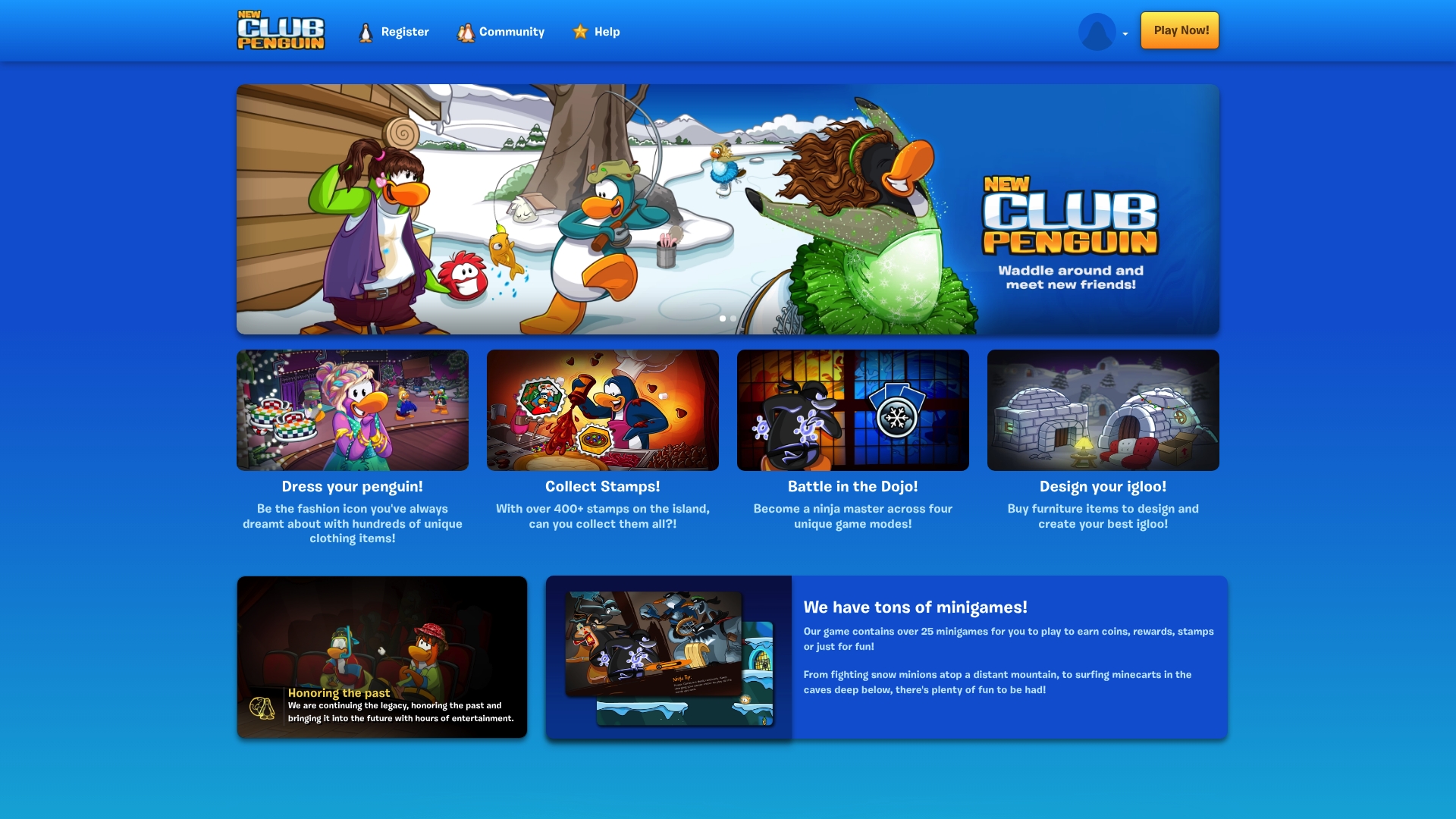
Newcp rebuilds the snow-covered rooms, the Puffle care, the igloo decoration, and the minigames that made the original so memorable. The platform runs with volunteer moderation focused on keeping the space safe for younger players and welcoming for returning adults. New seasonal events and clothing items give even longtime fans something fresh to find. You can join Newcp today at no cost, customize your penguin, and connect with a community of players who share the same love for this virtual world that you do.
FAQ
What is Club Penguin in simple terms?
Club Penguin is an online multiplayer game where players control penguin avatars in a snowy virtual world, socializing, playing minigames, and adopting virtual pets called Puffles. It ran from 2005 to 2017 and reached over 200 million registered users.
Is Club Penguin still available to play?
The original Club Penguin game closed in march 2017. Fan-run recreations like Newcp continue to offer a similar experience for free, with approximately 1 million active users across fan platforms as of 2026.
Why did Club Penguin shut down?
Club Penguin closed because its original code, built by artist-coders rather than traditional engineers, could not adapt to mobile devices. Disney shut down the browser-based game in march 2017 to focus on a mobile-first successor that ultimately also closed in 2018.
What were Puffles in Club Penguin?
Puffles were small, round virtual pets available in multiple colors, each with a distinct personality. Players adopted them, fed them, played with them, and walked them around the game world to keep them happy and healthy.
How do you play Club Penguin today?
Players can access fan-run recreations like Newcp for free through a web browser. After creating an account, players customize their penguin avatar, explore themed rooms, play minigames to earn coins, and participate in community events.